
Micro-Influencer Marketing: Why Smaller Creators Convert, and How to Run a Program

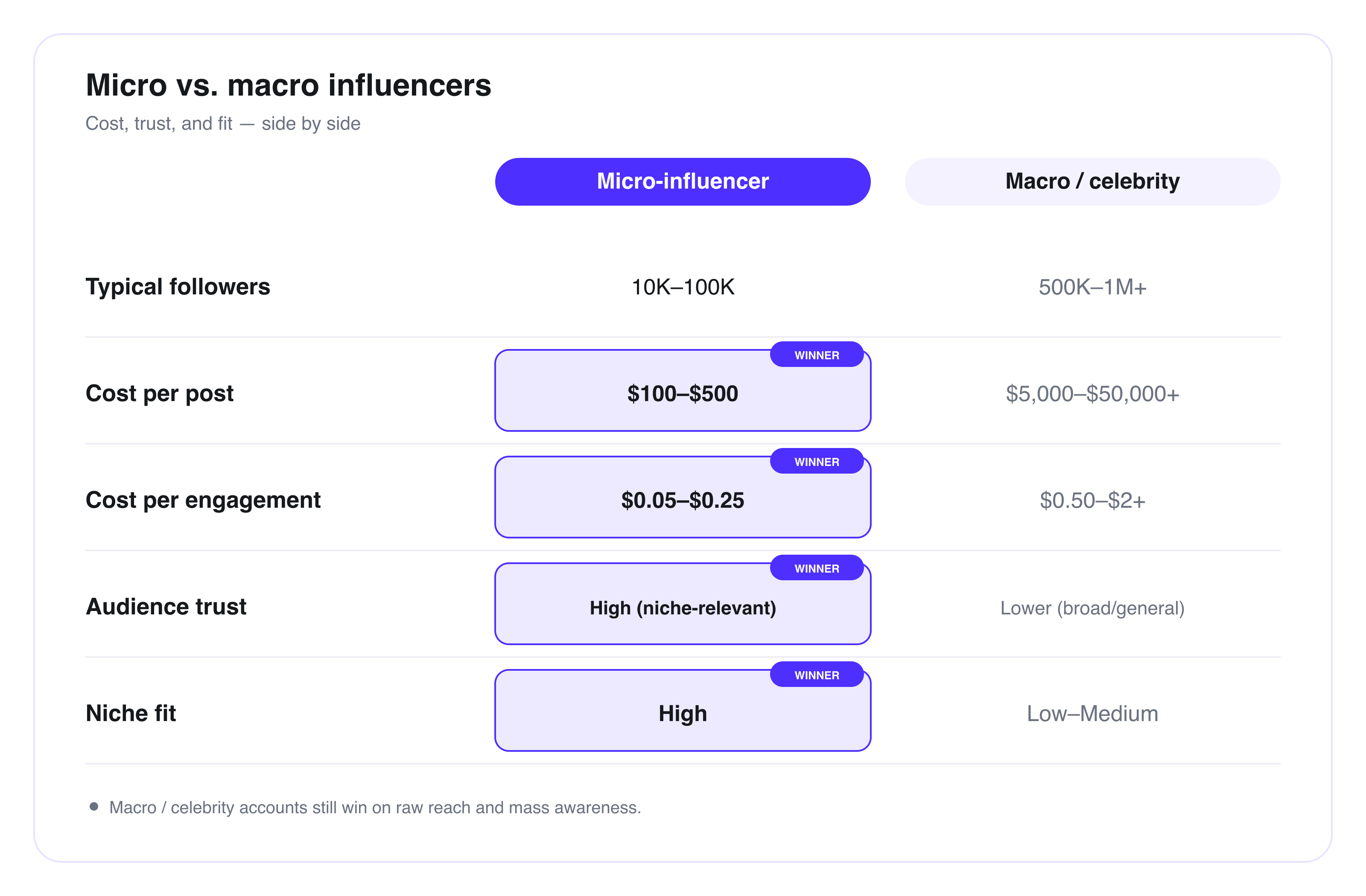
A $300 post from a 35,000-follower baking creator will often outperform a $50,000 post from a celebrity with 2 million followers. That's not because smaller is inherently better. It's because you're buying a different thing. With micro-influencers, you're buying audience relevance at $0.05–$0.25 per engaged action. With celebrity reach, you're buying attention at $0.50–$2+ per action, most of it wasted on people who were never going to buy anything. That's the whole argument. Everything else in micro-influencer marketing is execution.
Most brands that try this and quit blame the tier. What actually happened is they ran one or two micro-influencers like mini-celebrities: a single hero post, crossed fingers, no repeatable process. The tier isn't a scaled-down casting call. It's a media-buying discipline that needs portfolio math and a real pipeline.
What actually counts as a micro-influencer
One common convention sorts creators into rough bands by follower count:
- Nano — Follower range: 1,000–10,000
- Micro — Follower range: 10,000–100,000
- Mid-tier — Follower range: 100,000–500,000
- Macro — Follower range: 500,000–1,000,000
- Mega / celebrity — Follower range: 1,000,000+
Treat these as sorting buckets, not quality signals. Follower count tells you almost nothing about whether a creator's audience will buy your product. A 40,000-follower account can be built on three years of consistent, real community, or on a bot farm and engagement pods bought in a weekend. Both show up identically in a follower-count filter.
Here's the concrete version. A regional home-baking creator with 35,000 followers, 70% of whom live in the same metro region and actively follow kitchen and cooking accounts, is sitting on an audience that's functionally in-market for your stand mixer. A lifestyle creator with the same 35,000 followers, scattered across 40 countries with no coherent interest cluster, is sitting on reach: attention with no purchase-intent overlap. Same follower count, same tier, completely different asset. The follower band gets you into the right neighborhood. Audience composition tells you whether anyone in that neighborhood is going to buy.
Why micro-influencers convert better than macro and celebrity talent
Rates scale roughly like this, per post, across platforms (Instagram, TikTok, YouTube Shorts):
- Nano — Typical rate per post: $10–$100
- Micro — Typical rate per post: $100–$500
- Mid-tier — Typical rate per post: $500–$5,000
- Macro — Typical rate per post: $5,000–$10,000+
- Celebrity / mega — Typical rate per post: $10,000–$250,000+
That top band understates the real ceiling. A-list global celebrities and top athletes routinely command $500,000–$1,000,000+ for a single sponsored post, which is what the open-ended "+" is quietly hiding.
Now do the arithmetic that actually matters: cost per engaged action.
cost per engagement = post fee ÷ total engaged actions (likes + comments + saves + shares)
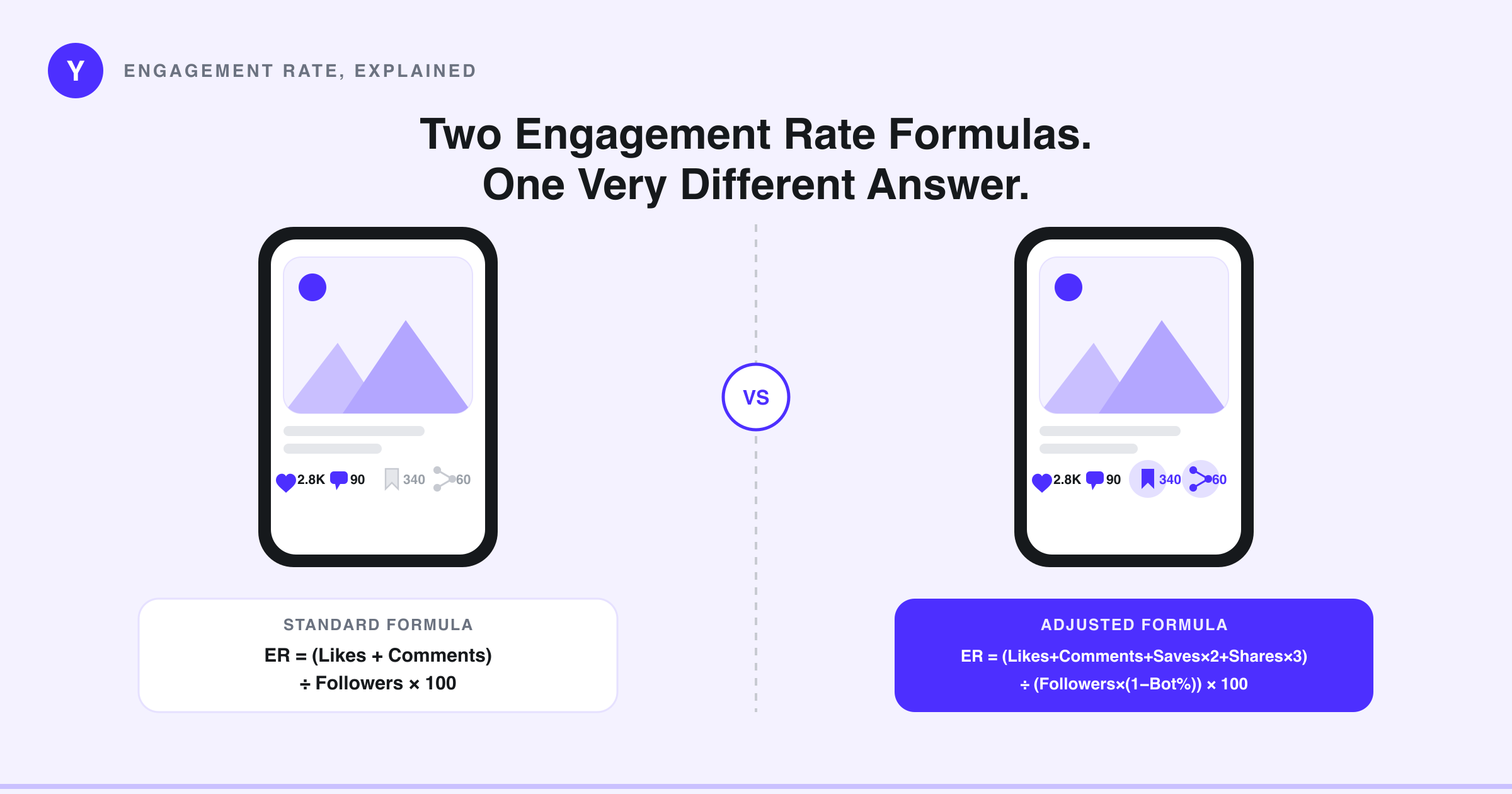
A $300 micro post that generates 1,500 engaged actions runs about $0.20 per engagement. A $50,000 celebrity post that generates 40,000 engagements runs about $1.25 per engagement. That's about 6.25x more expensive per action, and "engagement" there is still just an attention proxy. It hasn't accounted for whether any of those 40,000 people are even remotely in your target market. Engagement rate is worth a quick sanity check on any creator you're vetting: run the numbers with an engagement rate calculator before you go further. Treat it as a supporting signal, though, not the deciding one: a like isn't a sale, and an 8% engagement rate on a bot-inflated audience still converts at zero.
The trust math compounds the cost math. When a specific gear reviewer with 22,000 subscribers recommends a headlamp, their audience reads it the way they'd read a friend's recommendation, because that creator has actual category credibility: years of gear reviews and a track record of saying when a product is mediocre. When a general celebrity holds up the same headlamp in a sponsored post, the audience reads it as an ad, because it is one, and everyone knows it. Niche fit is what converts. Raw reach is what gets impressions. Those are different line items on a media plan, and conflating them is the single most common budgeting mistake in this category.
Micro vs. macro: the trade-off you're actually making
The micro vs macro influencers decision isn't "cheap vs. expensive." It's reach vs. relevance, and you should make that trade-off on purpose rather than by accident.
Put $50,000 into one macro creator with 2 million followers and you'll realistically see 400,000–600,000 actual reach after algorithmic decay and the fraction of followers who see any given post. That reach is broad and largely undifferentiated. You're showing up in front of people who like the creator, not people who are pre-disposed to your category.
Put the same $50,000 across 100–150 micro creators averaging 30,000 followers each, and you get roughly 3–4.5 million combined followers. That's a bigger number on paper, but the real difference is concentration. Each of those audiences is self-selected into a niche: home organization, trail running, specific parenting stages, regional food culture. You're not buying attention; you're buying 100–150 distinct pockets of purchase intent, each validated by a creator who has spent years building credibility in exactly that niche.
Macro and celebrity still win in specific situations: a pure brand-awareness launch where the goal is "everyone in the category has heard of us," a category-defining moment where you need one unmistakable image, or a single trust-transfer face (an athlete, a chef, a doctor) whose personal credibility is inseparable from the product claim. Micro wins everywhere else: performance campaigns, lower-funnel conversion, local or niche targeting, and creative testing, because 100 small bets let you find your best-performing angle before you commit real money to one macro deal you can't easily undo.
Micro vs. macro influencers: the real numbers
How to run a micro-influencer program at scale
Once you're past a handful of creators, this needs a pipeline, not a vibe.
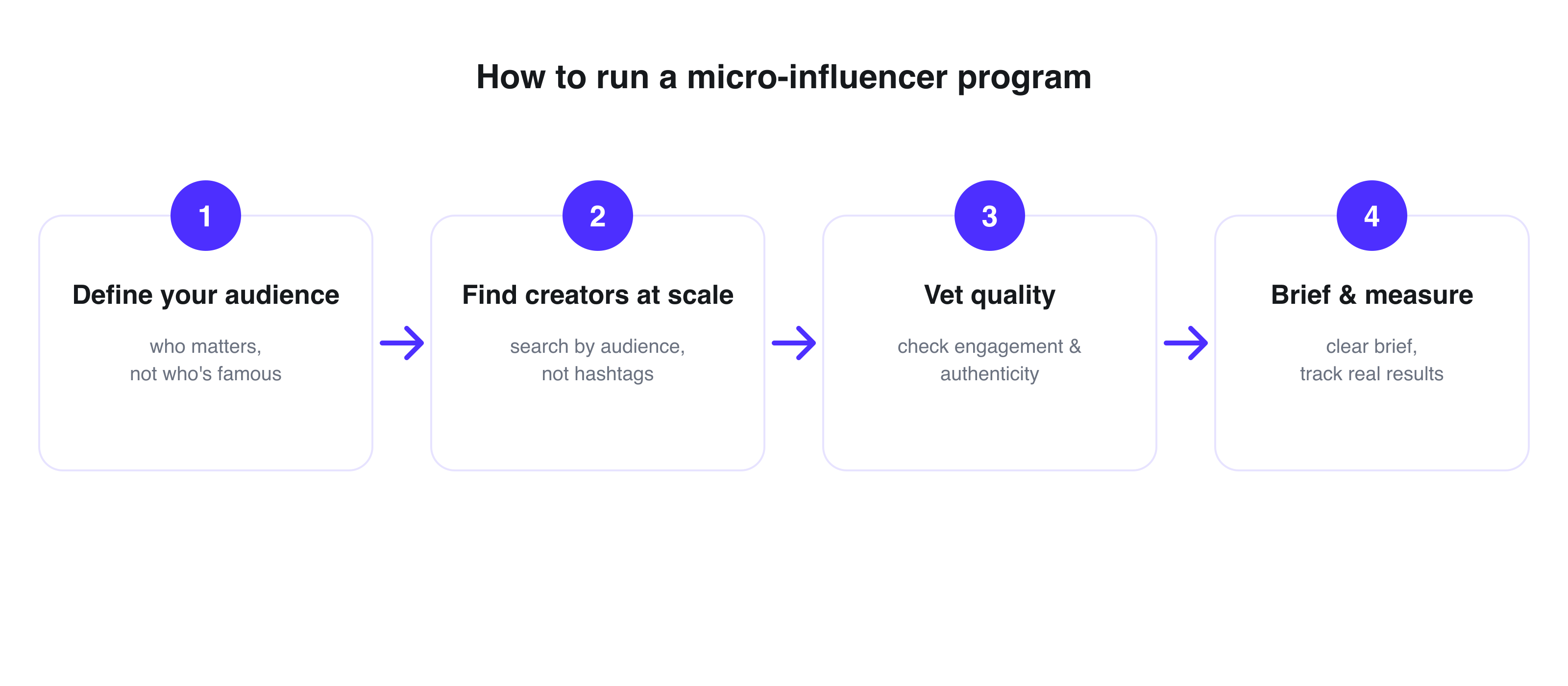
1. Define your audience first, not a content category. "Lifestyle" isn't a target. "Women 25–34 who follow 3+ home-organization accounts and live in the top 20 US metros" is. The more specific the profile, the more precisely you can match creators to it, and the fewer wasted sends you'll make later in outreach.
2. Find creators by audience composition, not hashtags. Hashtag search and manual scrolling top out around 20–30 creators before it becomes unmanageable; you run out of patience long before you run out of relevant creators. Searching by who actually follows a creator, rather than what they post about, is how you find micro-influencers by audience at the volume this tier requires.
3. Vet every creator's actual audience before you pay anyone. Geo match, real-follower percentage, audience age and gender fit: these are the filters that separate the 35K in-market baker from the 35K scattered lifestyle account. Budget for attrition in outreach. Response rates typically run 15–30%, so if your target is 100 signed creators, you need roughly 330–670 initial contacts. Before any contract, check their audience quality the same way you'd check a media buy's targeting before spending on it.
4. Brief and measure like a media buy. Standardize a short brief (three key messages, a do/don't list, and a disclosure requirement) so 100 creators don't produce 100 wildly different interpretations of your product. Assign a unique promo code or UTM link per creator so every dollar is attributable to a specific post, not a campaign-wide guess. Lock contract terms up front: flat fee versus whitelisting or paid-amplification rights, and for micro deals, usage rights typically run 3–6 months, not in perpetuity.
How to run a micro-influencer program
Why spreadsheets break down past 20 creators
Vetting one creator's audience by hand means checking follower authenticity, geo split, engagement pattern, and whether the audience actually matches your target. Done properly, that's 20–40 minutes per creator. At 100 creators, that's roughly 33–67 hours of unpaid vetting labor before a single dollar reaches media. Add outreach tracking, contract terms, and unique-link management across a spreadsheet with 500 rows, and the process doesn't just get slow. It starts producing errors: duplicate outreach, missed follow-ups, creators paid without ever being vetted.
This is exactly why programs above 20–30 creators move off spreadsheets and DMs onto a platform layer built for audience vetting at scale. Tools like HypeAuditor helped establish this category in the first place, but platforms differ by orders of magnitude on database size (some index a few million profiles, others 100M+) and on whether audience-quality data is even available before you pay. See the direct breakdown in Yoloco vs HypeAuditor if you're evaluating which fits a program at this scale.
Micro-influencer marketing isn't a budget workaround for brands that can't afford macro talent. It's a different, more efficient way to buy purchase intent. The brands that treat it as a real media-buying discipline, with audience vetting and per-creator tracking, are the ones who make the cost-per-engagement math actually pay off.
FAQ
What is a micro-influencer?
A creator with roughly 10,000 to 100,000 followers on a given platform. The label describes audience size, not audience quality: a micro-influencer with a bot-inflated audience is worse for your campaign than a nano-influencer with 8,000 real, geo-matched followers.
How much do micro-influencers charge per post in 2026?
Typically $100–$500 per post, with rates climbing toward $5,000 as a creator approaches the mid-tier band (100K–500K followers). Rate depends more on niche, platform, and production quality than on follower count alone.
Do micro-influencers actually convert better than celebrities or macro creators?
For performance and conversion goals, generally yes, because their audiences are more concentrated by interest and the cost per engaged action runs several times lower, often around $0.20 versus $1.25 for celebrity posts. For pure awareness or category-defining launches, macro and celebrity reach still has a role.
How many micro-influencers should a brand run in a single campaign?
Most programs that see reliable results run 30–150 creators per campaign. Below 20–30, you don't have enough volume to average out individual creator variance or test creative angles. Above 20–30, you generally need a platform rather than manual tracking: spreadsheets can technically stretch to 150 rows, but not without vetting errors and missed follow-ups.
What's the difference between nano, micro, and mid-tier influencers?
Nano runs 1,000–10,000 followers, micro runs 10,000–100,000, and mid-tier runs 100,000–500,000. The practical difference isn't just size. Nano and micro creators tend to have tighter, more self-selected niche audiences, while mid-tier creators start trading some of that focus for broader reach.
Micro vs. macro influencers: which should you use?
Micro influencers (10K–100K followers) win for performance and conversion goals because their audiences are more concentrated by interest: cost per engaged action runs roughly $0.20 versus $1.25 for celebrity posts. Macro and celebrity talent (500K+) still make sense for pure brand-awareness launches or a single trust-transfer face like an athlete or doctor. Most brands running conversion campaigns get better ROI stacking 100+ micro creators than betting on one macro deal.
How do you find and vet micro-influencers for a specific niche audience?
Search by audience composition rather than hashtags or follower count, since hashtag search realistically tops out around 20–30 creators before it becomes unmanageable. Then vet each candidate's geo split, real-follower percentage, and audience demographics before paying anything. Plan for roughly 15–30% response rates on outreach, meaning about 330–670 contacts to land 100 committed creators.
Similar articles

How to Vet Influencers Before You Pay: A 6-Point Checklist
Every media kit you get from a creator is a sales document. It's built to close the deal, not to inform your decision,...

How to Find Influencers for Your Brand
The fastest way to find influencers for your brand is to search by who follows a creator, not just what that creator...
How to Calculate Engagement Rate (The Formula Most Guides Get Wrong)
Most engagement rate calculators give you a single number and let you believe it. Plug in likes, comments, followers,...
Find creators who actually move your audience
Define any audience, get the creators who really influence it — with engagement and audience quality up front. Free to start.