
How to Vet Influencers Before You Pay: A 6-Point Checklist

Every media kit you get from a creator is a sales document. It's built to close the deal, not to inform your decision, and most brands still wire a deposit on nothing more than a follower count and a screenshot. This checklist replaces that screenshot with six pass/fail checks you run before you sign a contract, not after.
The media kit is marketing, not evidence
A media kit is a pitch deck with one slide. It's self-reported, self-selected, and built by the person who benefits most from you believing it.
Take the three numbers every kit leads with. Follower count is easy to inflate — bulk follower services sell 5,000 followers for $10-30, no verification required, delivered in a day. "Average engagement rate" is often calculated from a creator's three or four best posts, not the last 30; nobody screenshots the flop. And "audience demographics" comes straight from Instagram's own creator dashboard, which the creator controls entirely: they choose which date range to screenshot and which post's insights to pull from, and a single viral post with an unusual audience can skew the whole picture.
None of this means the creator is lying to your face. Most of the time you're not being deceived — you're being shown the best case, the same way a résumé shows only the wins. Your job isn't to catch a liar. It's to verify a claim before you pay for it.
This is how to vet influencers before you pay: a pre-payment workflow, not a vibe check. Six checks, each with a number attached:
- Is the engagement real or bought
- What percentage of the audience is fake
- Does the audience actually live where you're selling
- Are the comments from real people saying real things
- Is the account brand-safe, and who else have they been paid by recently
- Is the rate actually in line with reach and quality
Run all six with Influencer Analytics before the invoice, not after the post goes live. That's how to spot fake influencers before you wire a deposit — not after the campaign underdelivers.
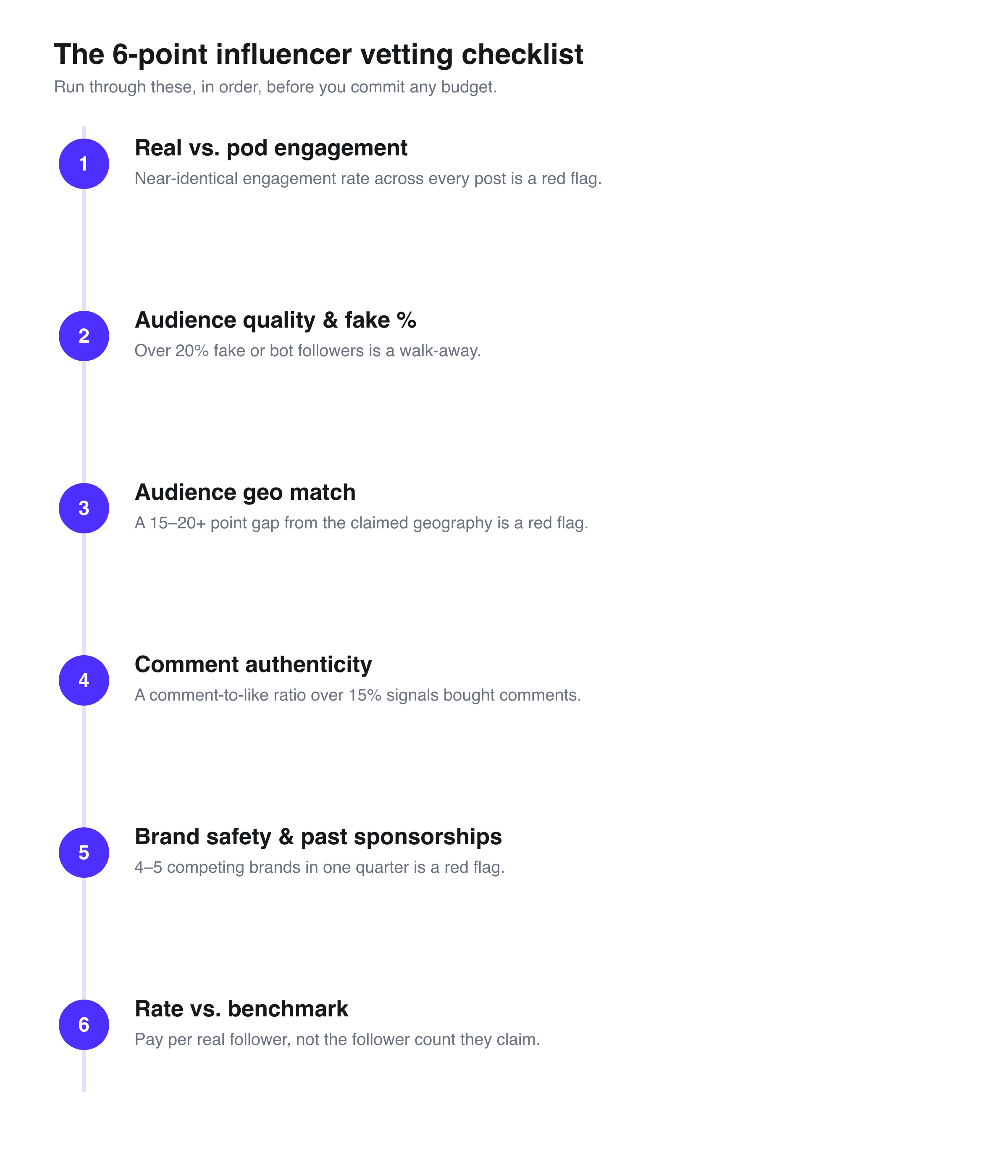
The 6-point influencer vetting checklist
Check 1: Is the engagement real or bought
Engagement pods — groups of creators who like and comment on each other's posts within minutes of publishing — leave a fingerprint. You don't need to recalculate the formula to spot it; you need to look for three signs.
First, flatness. Pull the last 10-15 posts and look at engagement rate post to post. Organic accounts wobble — a normal creator swings 1-3+ percentage points depending on whether a post is a selfie, a carousel, or a low-effort story repost. If the engagement rate barely moves, varying by less than 0.3-0.5 percentage points across every single post regardless of content, that consistency is the tell, not a strength.
Second, the same faces. Open the comments on five different posts. If the same 40-60 accounts show up on every one, commenting within 1-3 minutes of each post going live, you're looking at a pod, not a fanbase.
Third, speed that outruns reading. A caption takes 15-20 seconds to read. Comments that land in the first 5 seconds are automated or coordinated.
For a reference point, rough engagement benchmarks by tier look like this:
- Nano — Followers: 1K–10K · Typical ER: 5–8%
- Micro — Followers: 10K–100K · Typical ER: 2–4%
- Mid — Followers: 100K–500K · Typical ER: 1.5–2.5%
- Macro — Followers: 500K–1M · Typical ER: 1–2%
- Mega — Followers: 1M+ · Typical ER: Under 1%
A mega-tier creator whose media kit claims 6% engagement isn't an outlier success story — it's a number that should make you check the other five boxes twice as carefully. Don't trust the math on the kit; run the actual figure through the engagement rate calculator instead of whatever's printed on it.
Check 2: How to check for fake followers (and what percentage is normal)
This is the check most brands skip entirely, and it's the one that costs the most money when skipped.
The working thresholds:
- Under 10% fake/bot followers — normal. Every account accumulates some noise.
- 10-20% — a caution flag. Not a dealbreaker, but a legitimate reason to negotiate rate down.
- Above 20-25% — a walk-away number for most budgets, regardless of how good the content looks.
"Fake" isn't just eggs and empty bios. A real audit counts bot accounts, inactive accounts (no posts in 12+ months, following thousands, followed by almost no one), and mass-follow/unfollow accounts that exist purely to farm follow-backs. None of those show up on a manual scroll through the follower list.
The specific tell of purchased followers: a spike of 5,000-20,000 new followers inside a 48-72 hour window, with zero corresponding bump in comments, story views, or DMs. Real growth is messy and gradual. Bought growth arrives all at once and does nothing.
This is exactly the guesswork Influencer Analytics replaces — run the audience-quality and fake-follower audit before you negotiate rate, not after. If you're vetting a single creator for a one-off campaign and don't need a full platform login, the free Instagram audit does the same fake-follower check on its own.
Check 3: Does the audience actually live where you're selling
Here's a pattern that shows up constantly: a creator's media kit says "70% US audience." You pull the actual number and get 42% US, 23% Indonesia, 14% Brazil, the rest scattered across a dozen countries. Nobody lied outright — the creator likely screenshotted a single best-performing post's insights, which skewed toward whatever region that post happened to reach, and called it representative.
The working rule: a gap of more than 15-20 percentage points between claimed and audited geo is a rate-renegotiation trigger at minimum, a walk-away at worst. This matters far more for location-bound offers — US-only promo codes, regional retail chains, local services — where a mismatched audience means your conversion rate craters no matter how good the content is. A gorgeous Reel in front of the wrong country is a gorgeous Reel that converts at zero. It's the same influencer audience quality question as Check 2, just applied to geography instead of authenticity — pull both from the same audit, not two separate ones.
Check 4: Are the comments from real people saying real things
Comments are cheaper to fake than likes, which is exactly why they're a better tell.
The ratio to watch: organic Instagram posts typically generate 1-3 comments per 100 likes. When you see a comment-to-like ratio above 15%, that's far more commenting activity than an organic post naturally produces, and it usually points to a comment pod or purchased comments rather than genuine interest. The flag sits well above that 1-3% baseline on purpose — some niches (fandoms, giveaways, tight-knit communities) run genuinely chatty, and you want the threshold catching manipulation, not punishing real engagement. Past 15%, though, you're beyond what organic conversation produces.
What fake comments actually look like:
- Single emoji strings — "🔥🔥🔥", "😍😍", nothing else
- Generic praise copy-pasted across multiple posts word for word — "Amazing content!!", "Love this so much"
- Comments from accounts with zero posts and default gray avatars, posted within seconds of publish
A real comment does one of three things: references something specific in the photo or caption, asks a genuine question, or replies to another commenter. If you scroll 20 comments deep and every single one could have been copy-pasted onto a random post from a different account, that's your answer — and it usually confirms what the follower audit already flagged.
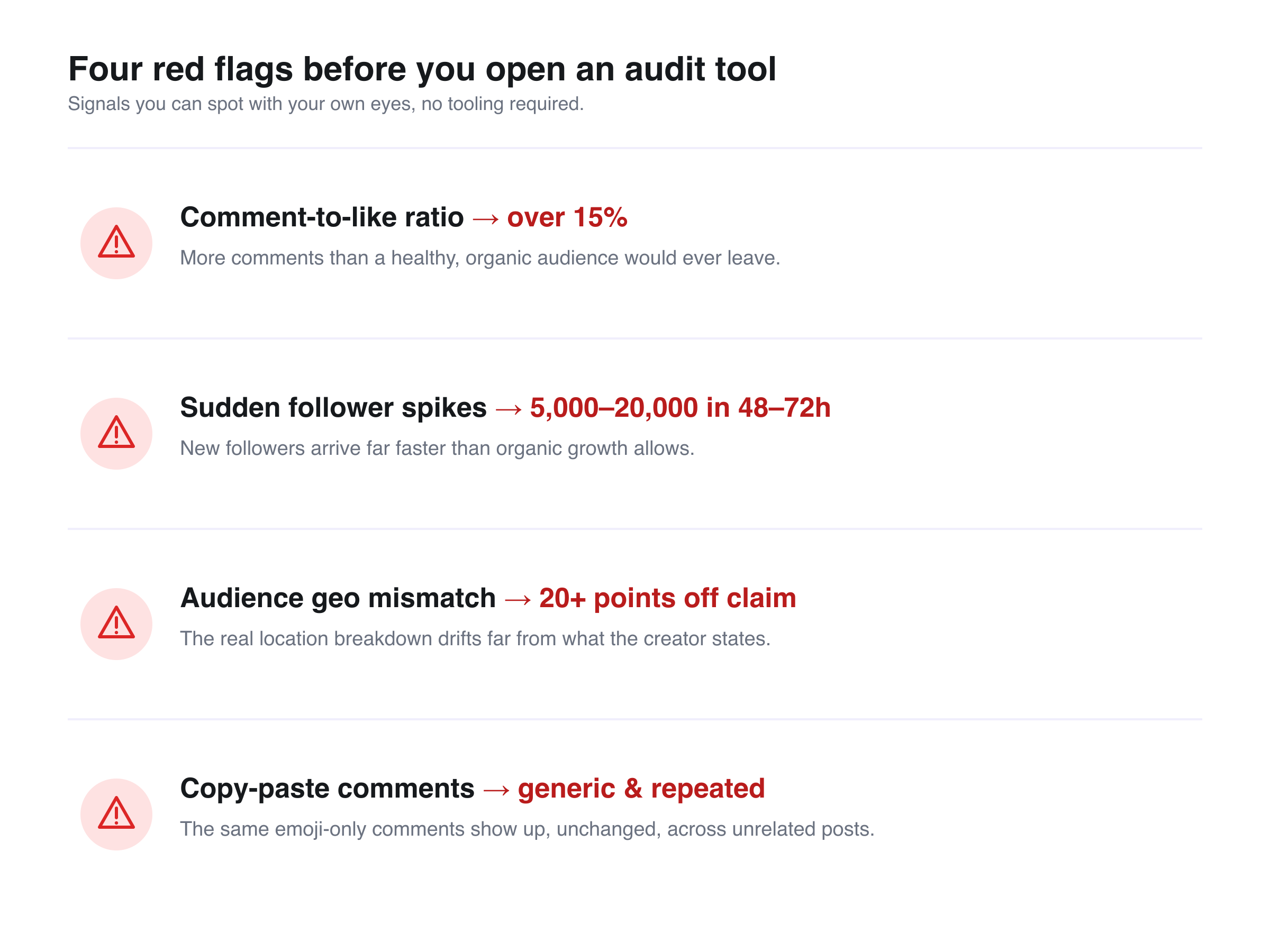
Four red flags that show up before you've even opened an audit tool
Check 5: Is the account brand-safe, and who else have they been paid by
Two sub-checks here, both with numbers attached.
First, scroll the last 20-30 posts for controversy, political flashpoints, or content that clashes with your brand's category. This takes five minutes and it's the check most likely to save you a genuinely bad week.
Second, count paid partnerships across the last 60-90 days. A creator repping four or five competing brands in your exact category within a single quarter isn't an endorsement anymore — to their audience, they read as a rented megaphone, and audiences tune those out fast.
There's a measurable cost to this even before brand-safety concerns kick in: studies commonly find sponsored posts see meaningfully lower engagement than organic, often 20-40% below. A feed where more than 40-50% of content is sponsored is already showing audience ad-fatigue before your post ever goes up — you're paying full rate to reach an audience that's partially stopped paying attention.
Check 6: Is the rate actually in line with reach and quality
Rough Instagram feed-post benchmarks, using the same tiers as Check 1:
- Nano — Followers: 1K–10K · Typical rate: $10–$100
- Micro — Followers: 10K–100K · Typical rate: $100–$800
- Mid — Followers: 100K–500K · Typical rate: $800–$3,000
- Macro — Followers: 500K–1M · Typical rate: $3,000–$8,000
- Mega — Followers: 1M+ · Typical rate: $8,000–$25,000+
These swing hard by niche — finance and B2B run well above these numbers, lifestyle and beauty run more saturated and cheaper — but they're a real anchor to sanity-check a quote against.
The actual rule underneath the table: you're paying for verified reach, not claimed reach. If Check 2 came back showing 20% fake followers, the real cost-per-real-follower on that rate just rose about 25% — you're paying for 100% of the audience but reaching 80% of it — and that math should change the number you counter with, not get filed away as a footnote after you've already agreed to the headline rate. If you're comparing audit tools to make this call at volume rather than one creator at a time, see Yoloco vs HypeAuditor.
Running all six checks without doing it manually every time
Six manual checks per creator are fine for one partnership. The process falls apart past 5-10 partnerships a quarter — nobody has the hours.
The fix isn't a faster manual process. It's flipping the order: vet audience quality before outreach even starts, not after a creator sends you a rate card you now have to unwind. Searching a database of 400M+ creators filtered by real audience geo, quality score, and engagement history means every candidate you approach has already cleared Checks 2, 3, and 6 before you've done Check 1.
The checklist holds up fine when you're vetting one creator at a time. But the brands that actually stop wasting budget are the ones who make vetting the default step before outreach — not a favor they extend to a creator who happened to look sketchy. Start from find pre-vetted creators and search by audience quality and geo instead of auditing one relationship at a time after the fact.
FAQ
How do you vet an influencer before paying them?
Run six checks before you sign: whether the engagement is real or pod-driven, what percentage of the audience is fake, whether the audience lives in your target market, whether the comments are genuine, whether the account is brand-safe and over-monetized, and whether the rate matches verified reach. Each check has a number attached, so the answer is pass/fail, not a gut call.
How much does it cost to run a fake follower audit on an influencer?
Free tools handle a single-creator, one-off check at no cost — the free Instagram audit is built for exactly that. Running audits at volume, across dozens of candidates before outreach, is where a paid platform like Influencer Analytics earns its keep.
What percentage of fake followers is considered acceptable for an influencer?
Under 10% is normal account noise. 10-20% is a caution flag worth negotiating rate down for. Above 20-25% is a walk-away number for most campaign budgets, regardless of how strong the content looks.
How can you spot a fake influencer with a high follower count?
A big follower number and a fake audience coexist more often at scale, not less — bulk purchases and gray-market growth services are used disproportionately by accounts chasing bigger rate cards. The tell isn't the follower count; it's the pattern around it: a flat, unchanging engagement rate across posts, a comment section full of copy-paste praise, and a follower spike of 5,000-20,000 in a 48-72 hour window with no matching bump in comments or story views. A high follower count paired with any of those is a bigger red flag than a small account with the same symptoms.
How do I check an influencer's engagement rate without paying for a tool?
Pull likes and comments from the last 10-15 posts manually and run them through the engagement rate calculator rather than trusting the average printed in a media kit. What matters more than the single number is whether it's consistent across posts — flat, unmoving engagement is the actual warning sign, not a low number on its own.
What's the difference between a comment pod and organic engagement?
A comment pod is a coordinated group of accounts that like and comment on each other's posts within minutes of publishing, usually the same 40-60 accounts across every post. Organic engagement is messier — different commenters post to post, comments arrive over hours not seconds, and the engagement rate itself fluctuates 1-3+ percentage points depending on the content, rather than sitting flat.
Should I still pay a creator if their audience geo doesn't match my target market?
Depends on the offer. For a national brand-awareness play, a geo mismatch under 15-20 percentage points off your claim is workable. For anything location-bound — a US-only promo code, a regional retailer, a local service business — a mismatch that size should trigger a rate renegotiation or a walk-away, because your conversion rate will crater no matter how strong the content is.
Similar articles

Micro-Influencer Marketing: Why Smaller Creators Convert, and How to Run a Program
A $300 post from a 35,000-follower baking creator will often outperform a $50,000 post from a celebrity with 2...

How to Find Influencers for Your Brand
The fastest way to find influencers for your brand is to search by who follows a creator, not just what that creator...
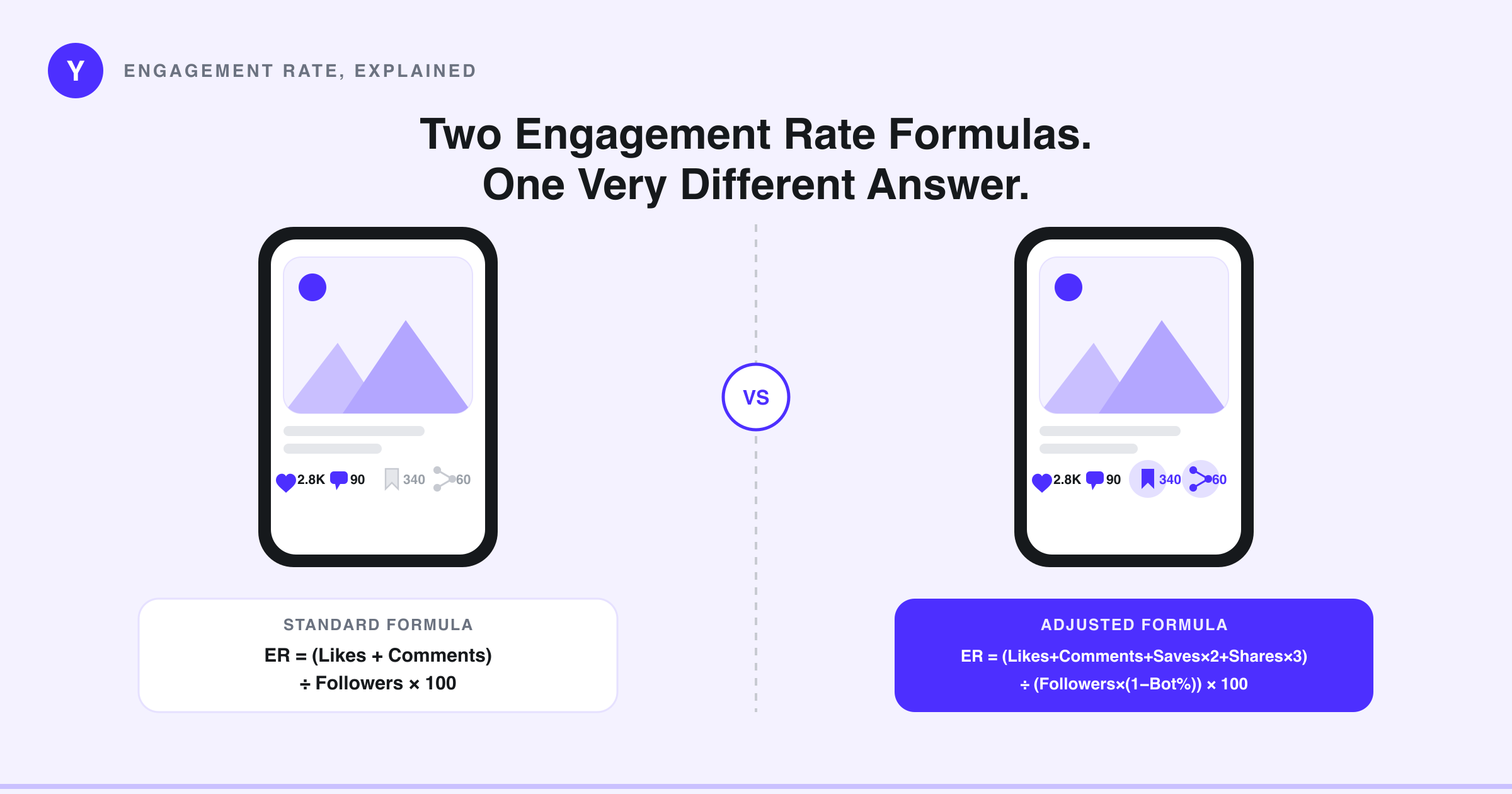
How to Calculate Engagement Rate (The Formula Most Guides Get Wrong)
Most engagement rate calculators give you a single number and let you believe it. Plug in likes, comments, followers,...
Find creators who actually move your audience
Define any audience, get the creators who really influence it — with engagement and audience quality up front. Free to start.